
What Is a Prop Firm CRM?
Proprietary trading firms run on a very different model from traditional Forex or CFD brokerages. They don't earn mainly from spreads or commissions. They design trading challenges, judge trader performance against strict rules, allocate capital and manage risk across a large number of traders at once.
A Prop Firm CRM is the operational backbone that keeps all of this running when there are thousands of accounts. It isn't a sales CRM, and it isn't a standard brokerage back office either. It's a rule-driven infrastructure layer built to manage challenges, enforce dynamic rules, watch trader behavior in real time, catch abuse patterns, automate evaluations and control payouts and account scaling. This document covers what a Prop Firm CRM is, how it differs from a brokerage CRM, and what architecture a sustainable prop trading business needs.
Why Prop Firms Require a Specialized CRM
Retail proprietary trading firms have created a new category of financial infrastructure. They sell trading challenges, assess discipline and consistency, allocate simulated or real capital, enforce strict risk parameters and keep watching how traders behave.
A broker doesn't police its clients' trading this way. A prop firm enforces several layers of rules: daily loss limits, maximum trailing drawdowns, profit targets, minimum trading days, news trading restrictions, consistency requirements and prohibited strategies. All of that needs continuous monitoring, real-time calculation and automatic enforcement.
A traditional CRM wasn't built for this. A Prop Firm CRM has to be a rule execution engine, a real-time monitoring system, a behavioral analytics platform and a payout governance layer, all at the same time.
Without that kind of specialized infrastructure, a prop firm is exposed: rules get enforced inconsistently, traders exploit the challenge logic, fraudulent trading slips through and money leaks out.
Core Components of a Prop Firm CRM
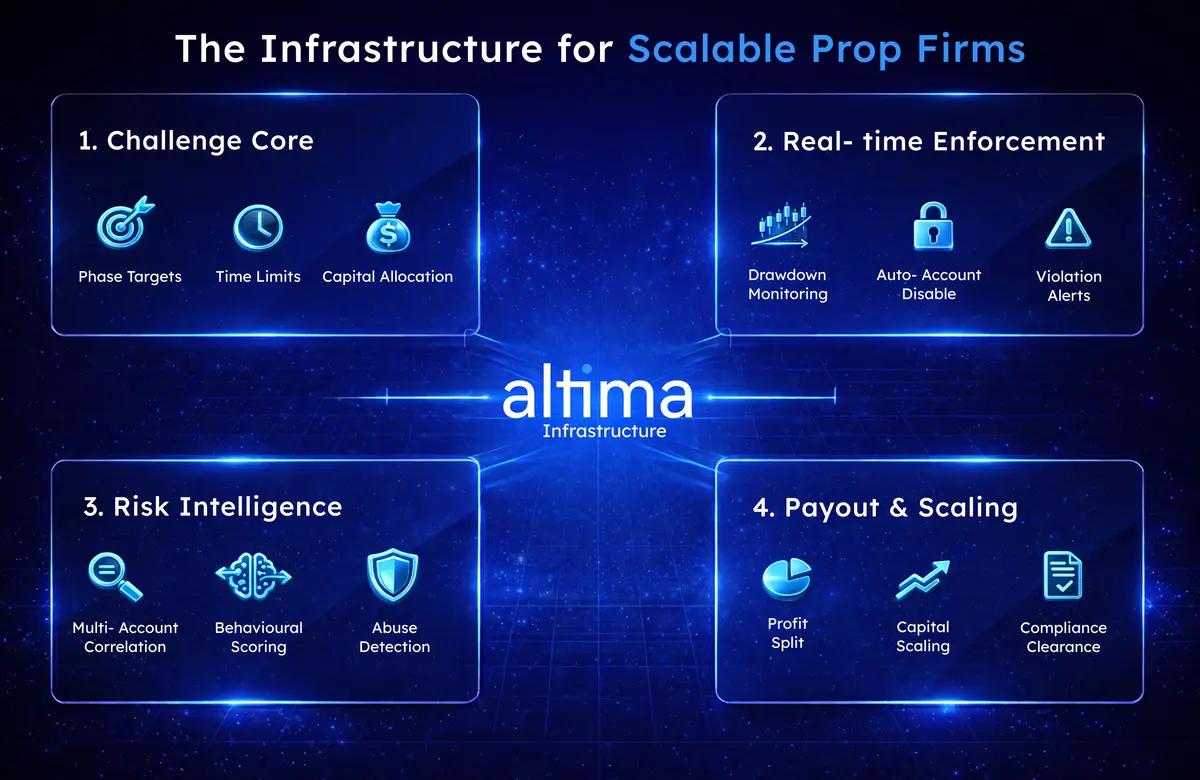
A solid Prop Firm CRM is a set of tightly integrated modules working together in real time. Typically that means challenge management, a rule engine, trade ingestion and monitoring systems, abuse detection mechanisms, risk scoring frameworks, payout automation, and trader lifecycle management.
The pieces have to stay in sync so that trader activity is evaluated continuously, rules are enforced instantly and decisions don't wait for a person to click something.
Challenge Management Logic
The trading challenge system is the center of every prop firm. Most firms run evaluations in phases: an initial profit target under strict drawdown limits, a second phase with adjusted targets, then a funded stage where capital is allocated.
The CRM tracks each trader's progress through these stages, detects when qualification criteria are met, upgrades accounts that pass and disables accounts that fail. Tracking this by hand stops working long before you reach a few thousand accounts.
Profit targets have to be enforced precisely, taking into account net profit, floating versus closed profit, realized equity, and adjusted balances. Even small calculation errors can lead to incorrect pass approvals or unfair disqualifications.
Drawdown management matters just as much. The system needs to support static drawdowns, trailing drawdowns and daily loss limits. Trailing drawdown in particular needs real-time equity tracking, because the allowed loss threshold moves up each time account equity reaches a new high.
Many firms also set a minimum number of trading days to test consistency. The CRM has to recognize valid trading activity and filter out artificial behavior such as micro-lot manipulation. Time-based restrictions, including evaluation periods or trading limitations over weekends, must also be automatically enforced.
Rule Engine Explanation
If one component matters more than the rest, it's the rule engine. It checks trader activity against predefined conditions, automatically and without pause.
It is event-driven. Trade openings, trade closures, equity updates and balance changes each trigger rule validation in real time.
Rules cover several categories, including profit thresholds, daily loss limits, overall drawdowns, news trading restrictions, prohibited strategies, lot size limits, and leverage controls. Better systems let you configure these per challenge type, account structure or trading instrument.
Violations have to be caught in real time. The system flags the breach, disables the account where necessary, logs it and notifies the risk team. Every minute of delay adds financial exposure.
Abuse Detection & Risk Monitoring
What separates prop firms that last from those that don't is often how well they detect and prevent abuse. Traders may attempt to hedge across multiple accounts, mirror trades between accounts, or exploit opposing positions. The CRM catches this through correlation analysis, looking for identical lot sizes, mirrored trades and shared IP activity.
Multi-account exploitation is common too, where traders distribute risk across several accounts or use copy trading strategies to guarantee at least one successful outcome. Spotting it means watching payment methods, device fingerprints, IP addresses and behavioral patterns.
Then there's latency arbitrage, where traders exploit delays in price feeds or execution. To counter it, the CRM needs execution logs, timestamp analysis and slippage tracking.
Some firms restrict trading during high-impact news events or weekend gaps. The system finds trades placed in restricted periods by matching activity against economic calendars.
Strategy consistency monitoring picks up prohibited approaches such as martingale, grid trading, or high-frequency trading by analyzing order frequency, lot progression, and holding durations.
Real-Time Trade Monitoring Infrastructure
Prop firms deal with high trading volumes, sometimes thousands of trades at the same moment. The CRM has to ingest tick-level data, order-level information, equity updates, and margin changes in real time.
That calls for high-frequency ingestion pipelines, event-driven processing and database structures that can absorb large volumes of trading data without adding latency.
Payout Governance & Capital Scaling
Once traders pass evaluation, payouts become the main concern. Most firms operate on profit-sharing models such as 70/30, 80/20, or 90/10 splits. The CRM calculates eligible payouts, accounts for any violations and applies scaling rules where they apply. Capital scaling allows firms to increase account size as traders reach performance milestones or demonstrate consistency. The system detects eligibility, upgrades the allocation and keeps a clear record of scaling history. Withdrawal controls matter as much. Before any payout goes out, the CRM checks that no rules have been violated, minimum holding periods are met, and compliance checks are completed. Automate payouts without these checks and you will pay out money you shouldn't.
Trader Lifecycle Management
A Prop Firm CRM covers the trader's whole lifecycle: lead generation and account purchase, challenge activation and evaluation, the funded stage and payouts, and suspension or termination if it comes to that.
Automating it cuts a lot of operational overhead, and every trader account gets treated by the same rules.
Key Differences Between Brokerage CRM and Prop CRM
A brokerage CRM is mainly designed for client management, deposits, withdrawals and IB tracking. A Prop Firm CRM is built around challenge logic, rule enforcement, abuse detection, and capital scaling.
Features such as drawdown tracking, real-time rule validation, and behavioral monitoring are core requirements in prop trading, and brokerage systems have little or none of them. You can't repurpose a brokerage CRM for a prop firm without significant redevelopment.
Architecture Requirements
A production-grade Prop Firm CRM needs serious architecture that can grow with volume. Usually that means a dedicated rule engine microservice, a trade ingestion layer, real-time monitoring, behavioral analytics, secure payout modules and full audit logging.
High availability, redundancy and fault tolerance keep it running without interruption and limit both financial and reputational damage when something fails.
Conclusion
A Prop Firm CRM is the foundation a proprietary trading business grows on. Without structured challenge management, real-time rule enforcement, abuse detection, continuous risk monitoring and automated payouts, a prop firm can't run efficiently or securely.
Whether a prop firm lasts a year or becomes an institutional-grade business usually comes down to how deep its infrastructure goes, how precisely its rules are applied and how well its monitoring catches what traders try.
Frequently asked questions
What is a Prop Firm CRM?
It's a specialized operational system for proprietary trading firms. It manages trading challenges, enforces rules, monitors trader behavior in real time and controls payouts and account scaling.
Why can’t prop firms use a standard CRM?
A standard CRM can't enforce trading rules, monitor real-time activity or detect abuse, and a prop firm needs all three to run challenges and manage risk.
What does a Prop Firm CRM manage in daily operations?
Challenge progression, rule enforcement, trade monitoring, abuse detection, payouts and the trader lifecycle from onboarding to funded account.
How does a Prop Firm CRM enforce trading rules?
A real-time rule engine checks every trade, equity change and account event, flags violations immediately and takes automated action.
Why is real-time monitoring critical for prop firms?
It catches rule breaches the moment they happen, stops abuse early and protects the firm from financial loss and exploitation.