
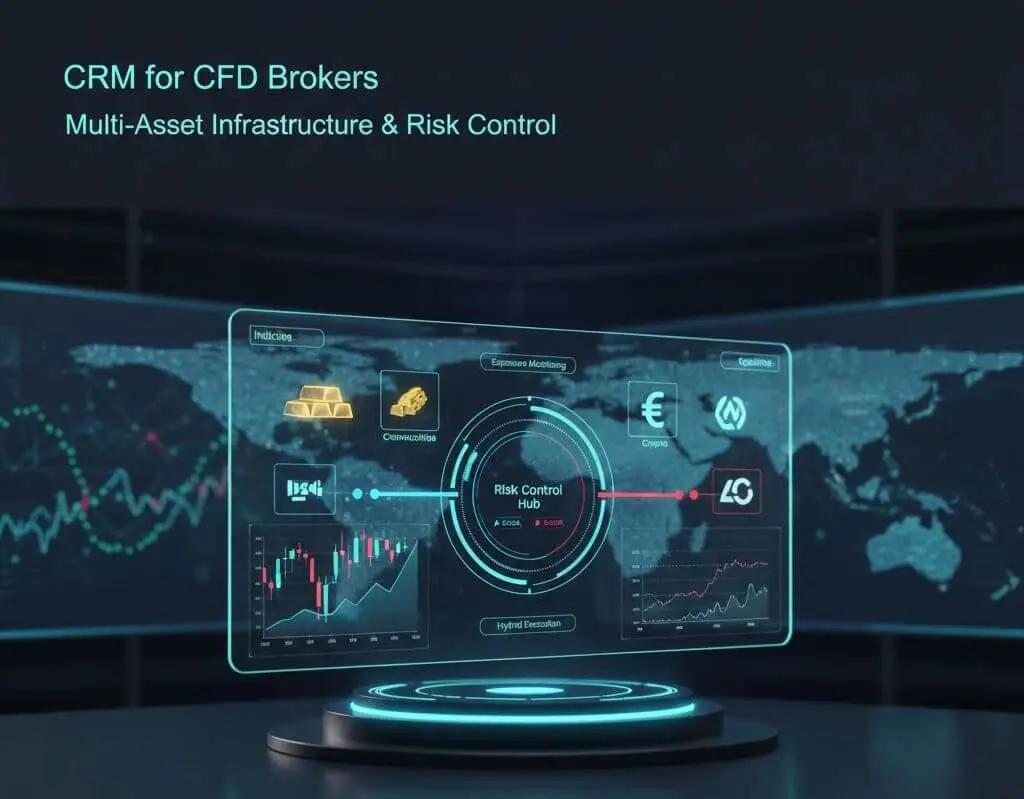
Infrastructure, Risk Control, and Operational Architecture
Contracts for Difference (CFDs) are one of the more complex corners of online trading.
From the outside a brokerage looks simple: people register, deposit and trade. Underneath, trading platforms, compliance systems, risk monitoring, payment infrastructure and partner networks all run at the same time and depend on each other.
The CRM sits in the middle of all that. For a CFD broker it is less a sales tool than the infrastructure layer that ties those components into one coordinated system.
What a CFD CRM Actually Does
A CFD CRM manages a client's whole lifecycle, from onboarding through trading activity to financial reconciliation, and keeps trading, payments, compliance and reporting in sync.
In practice that covers:
- onboarding and verification
- trading account creation
- real-time trade tracking
- IB commissions and rebates
- payment flows and wallet balances
- reporting across clients and revenue
Automation helps, but the real value is that every system agrees with every other system.
Why CFD Brokers Require Specialized Infrastructure
CFD brokerages run under conditions that are considerably more complex than most financial businesses. They handle multiple asset classes, dynamic leverage models and variable margin structures, plus swap calculations, corporate actions and strict regulatory oversight.
Generic CRM systems can't keep up with that. They can't track revenue accurately at symbol level, manage exposure across assets, or line up dealer execution with commission structures.
You need a specialized CRM that brings trading, risk, finance and compliance into one operational framework.
Managing Revenue Across Multiple Dimensions
Revenue in a CFD brokerage comes from several places at once: spread markups, commissions, swaps and financing adjustments. Each has to be tracked accurately by client, symbol, IB and asset class.
A good CRM captures and processes this data the same way every time. That is what stops revenue leaking out through gaps and keeps the finance numbers correct.
Leverage, Margin, and Risk Control
CFD brokers run dynamic leverage models that vary by asset class, region and client profile.
The CRM has to track margin usage, stop-out levels and leverage settings continuously. In volatile markets this is what keeps one problem from setting off several others. Without proper monitoring, small inconsistencies can turn into significant exposure surprisingly fast.
Deep Integration with Trading Platforms
A CFD CRM needs a direct integration with platforms such as MT4, MT5 and cTrader, and that integration has to go well past account creation. Balances, trades, commissions and market activity should sync continuously.
The trading platform executes. The CRM decides how that data is interpreted and used across the rest of the business.
Real-Time Data and Operational Accuracy
Delayed or batch-based systems don't work for a modern brokerage. The CRM should process trading data in real time and update risk metrics, revenue calculations and reports as activity happens, so decisions are made on current numbers rather than last night's snapshot.
Risk Segmentation and Dealer Coordination
Many CFD brokers run hybrid execution, with some flow on A-Book and some on B-Book.
The CRM does a lot of the work of segmenting clients by behavior, profitability and risk pattern. With it, brokers can:
- classify clients into execution categories
- monitor exposure across asset classes
- align dealer decisions with real-time data
Without that coordination it's hard to keep risk and profitability in balance.
IB and Affiliate Systems
Introducing Brokers drive a large share of growth for most CFD brokerages. Managing IB structures gets complicated, though, because commission models, asset classes and account types all vary.
The CRM calculates commissions accurately and ties them to actual trading revenue. Fewer disputes follow, and partners trust the numbers.
Payments and Financial Reconciliation
Financial operations run through the CRM as well. It links wallet systems, payment gateways and trading balances into one synchronized structure, so the back office can track deposits, withdrawals and balances accurately and spot discrepancies as they happen.
Compliance and Reporting
Regulation shapes a great deal of how a CFD brokerage operates.
The CRM has to support identity verification, AML checks, transaction monitoring and audit logging. It also reports on trading activity, financial performance and client behavior, which serves compliance and business decisions alike.
Scaling a CFD Brokerage
Complexity grows with the brokerage. More clients, more trades, more payments and more partners all put pressure on the system.
A well-designed CRM lets the business grow without losing control. Operations stay consistent, and management can still see performance and risk clearly at ten times the volume.
Final Perspective
A CFD brokerage is a multi-layered operational system, and the trading platform is only one of those layers.
The CRM is what connects them, bringing trading data, financial flows, risk management and compliance into one infrastructure. How deep that system goes decides how efficiently the brokerage runs and how far it can grow in a competitive market.
Frequently asked questions
What does a CRM for CFD brokers actually do?
It manages the full client lifecycle, from onboarding and KYC to trading activity, payments, commissions and reporting, and keeps all the connected systems in sync.
Why can’t CFD brokers use a generic CRM system?
Generic CRMs can't handle trading data, risk exposure or multi-asset revenue tracking, and a CFD brokerage depends on all three.
How does a CFD CRM help with risk management?
It monitors margin, exposure and leverage in real time, so brokers can control risk and react quickly when markets turn volatile.
Does a CFD CRM integrate with trading platforms?
Yes. It integrates with platforms like MT4, MT5 and cTrader and syncs trades, balances and commissions in real time.
How are IB and affiliate commissions managed in a CFD CRM?
The CRM calculates commissions automatically from actual trading activity. Partners can see how the numbers were reached, so there are fewer disputes.