
Updated guide: What Is a Prop Firm CRM? →
How Modern Prop Firms Build Controlled Infrastructure That Grows
People tend to see prop trading firms as marketing businesses built around challenges and payouts. The firms that grow successfully work very differently. Behind every serious prop firm is a structured system that governs how traders are onboarded, evaluated and paid.
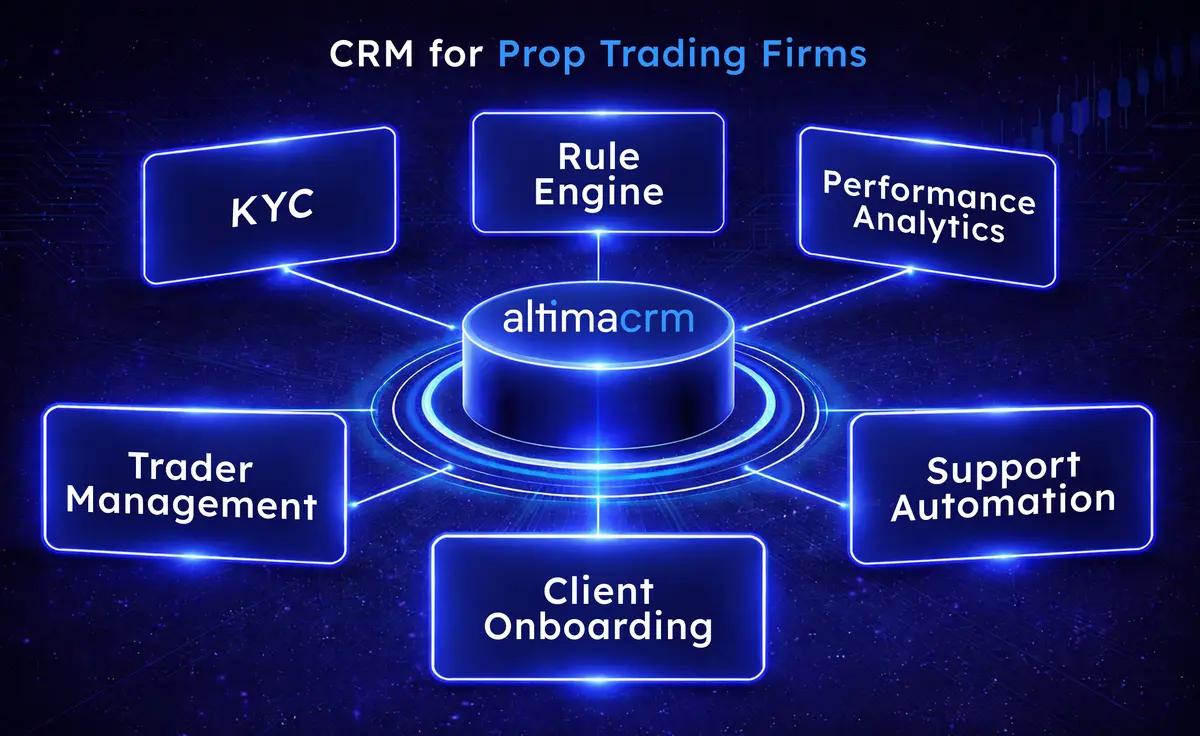
The CRM sits in the middle of that system. A CRM for prop trading firms does far more than hold records or log support tickets. It is the operational layer that ties risk controls, payout workflows, trading platforms and challenge rules together.
Why Prop Firms Require a Different Type of CRM
Standard CRM systems are designed to handle sales pipelines and customer
relationships. Prop traders run on an entirely different business model, which is why understanding what is a prop firm CRM matters. Every decision is tied to live trading activity. Passing a challenge, breaching a rule, qualifying for a payout: each depends on real-time data and strict evaluation logic.
So a CRM for prop trading firms has to process information in real time, not simply store it. That gets more important as the business grows. Something that copes with a few hundred traders falls over quickly once volume rises, and without a centralized system, delays, inconsistencies and disputes follow.
What a Prop Trading CRM Actually Does
A prop CRM supervises the trader's whole life cycle. It starts at onboarding, where the system captures user data, verifies identity where required and assigns the right challenge.
As soon as the trader logs in, the CRM connects to the trading platform. It tracks account activity, watches performance and keeps checking whether the trader is staying within the challenge rules.
It also processes payouts, records resets, manages payments and logs every action for audit and review. What matters is that all of this happens inside one system, so nothing gets lost between teams or tools.
The Challenge Engine: Where Rules Become Reality
The challenge system is the core of a prop firm. It is where business rules get defined and enforced.
Every challenge has conditions such as profit targets, drawdown limits and requirements for moving to the next phase. Those rules don't stay fixed. They change over time, vary by product, and may differ by region or during a promotion.
A well-built CRM lets the firm handle that complexity without losing control, and, more to the point, applies the rules consistently and in real time.
Real-Time Rule Enforcement
How rules are enforced is one of the clearest differences between basic setups and mature prop infrastructure.
In a mature setup, enforcement is instant. As trades execute, the CRM gets a continuous stream of updates on positions, equity and account status, and compares them with the configured rules to decide whether the trader is progressing, breaching a limit or failing. No one has to run manual checks, and every account is judged the same way.
Integration with Trading Platforms
A prop CRM needs deep integration with cTrader, MT4 and MT5. Creating accounts is the easy part. The system also has to process trade data, track balances, watch open positions and update challenge results the moment they change.
If that integration is weak, nothing else in the system can be trusted.
The trading platform executes the trades, but the CRM governs what happens around them, and keeping that line clear is what keeps the firm in control.
Risk Management and Abuse Detection
Risk in prop trading goes beyond market exposure. It includes trader behavior and deliberate abuse of the system. A good CRM watches for patterns such as account linkage signals, coordinated trading and repeated drawdown breaches.
It helps the team spot multi-accounting, copy trading across profiles and attempts to game the payout rules, so the firm can act on evidence rather than guesswork.
Managing Payouts with Control
Payouts are one of the most sensitive areas for a prop firm. They hit profitability directly and they decide whether traders trust the firm. A CRM runs the whole payout process.
Before approval, the system checks challenge completion, rule compliance, risk flags and account history. It then manages the request through to final payment and keeps a complete audit trail along the way, which cuts errors and protects the company.
Building for Growth
Operations get more complicated as a prop firm grows. More traders, accounts, trades and payouts all put extra load on the system.
With a well-designed CRM underneath, the company can grow and still stay in control. Manual work drops, processes stay consistent, and management can see both performance and risk clearly.
Final Perspective
A prop trading firm is an operational system built on rules, data and control, and the challenges are only the part customers see. The CRM is what holds the system together.
It links trading, risk, payouts and reporting so the business can grow in a structured, sustainable way. In most cases, whether a firm grows smoothly or struggles comes down to how solid this layer is.
Frequently asked questions
What is a CRM for prop trading firms?
It is a rule-based system that runs trading challenges, enforces rules in real time, monitors risk and controls payouts from one place.
Why do prop trading firms need a specialized CRM?
Because challenge results, rule violations and payouts all depend on real-time trading data, and generic CRMs can't process that data or enforce rules against it accurately.
What does a prop trading CRM manage daily?
The full trader lifecycle: onboarding, challenge tracking, rule enforcement, trade monitoring, payouts and audit logging.
How does a prop trading CRM enforce rules?
It tracks trades, equity and account activity continuously and compares them against the challenge rules, so progress, violations and failures are picked up the moment they happen.
How does a prop CRM help with risk and payouts?
It picks up abuse patterns, watches trader behavior, checks rule compliance and processes payouts with full control and an audit trail, which protects the business.