
Updated guide: Best CRM with MT5 Integration →
Architecture, Integration & Operational Control
MetaTrader 5 is a multi-asset trading system that handles Forex, CFDs, futures, stocks and exchange-traded instruments at high speed. What it doesn't give you on its own is the operational infrastructure needed to run a brokerage.
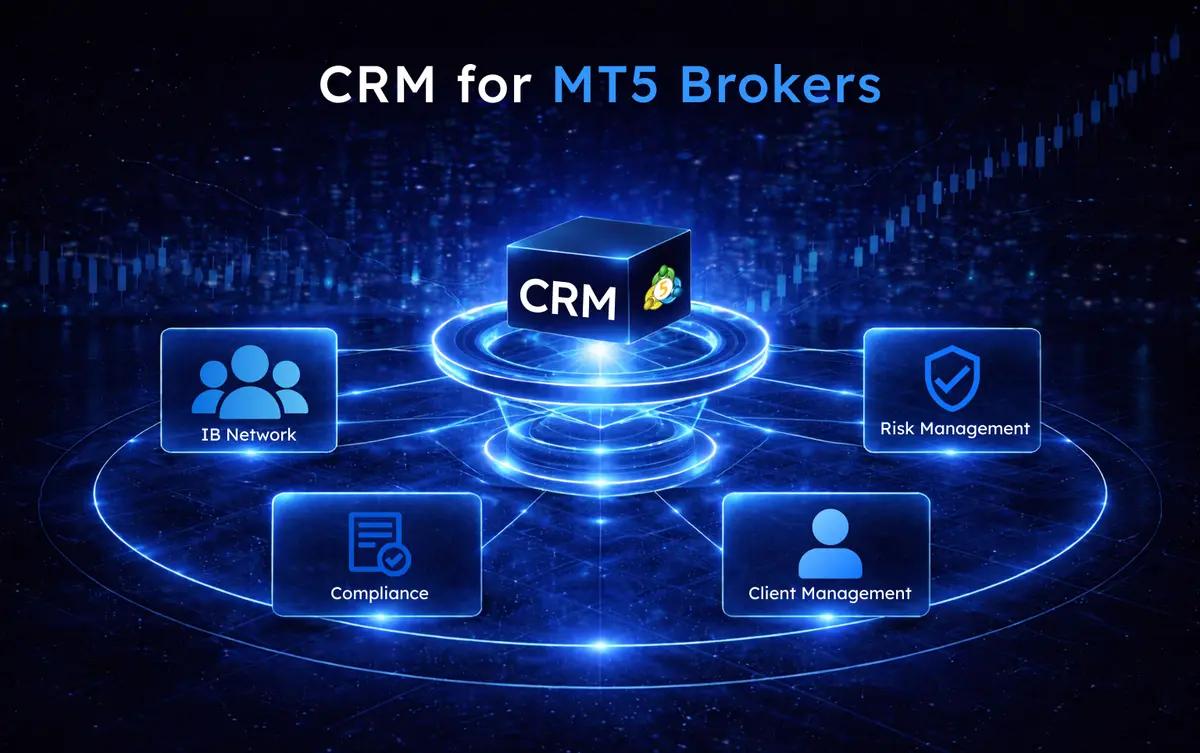
That is the job of a CRM for MT5 brokers. It connects the trading platform to back-office workflows: client onboarding, compliance processes, account provisioning, payments, IB commissions, risk monitoring, dealer coordination and reporting. Without a deeply integrated CRM layer, MT5 stays a trading terminal rather than a working brokerage system.
What a CRM for MT5 Brokers Must Handle
A CRM for MT5 brokers manages the trader's whole operational lifecycle, from onboarding and KYC verification through account creation, wallet management and payment processing. Once trading starts, it has to keep trade data, commissions, balances and reporting in sync all the time.
It also keeps trading, finance, compliance and risk working from the same data. That is what lets a brokerage run efficiently instead of splitting into departments that each hold their own version of the truth.
Why MT5 Brokers Require a Specialized CRM
MT5 is a lot more complex than earlier platforms. It supports multiple asset classes, advanced margin systems, and both netting and hedging modes. It also relies on gateway-based liquidity connectivity and dealer-level execution control.
A generic CRM system can't read MT5’s internal structure properly. It won't map account groups, symbol configurations, commission layers or dealer workflows accurately, and it can't ingest trades in real time at high volume. A specialized CRM is needed as the operational command center, turning MT5 data into business logic the back office can use.
Multi-Asset Complexity and Revenue Mapping
MT5 supports a wide range of asset classes, each with its own contract sizes, margin models, swap rules and commission structures. All of these feed straight into revenue calculations and risk exposure.
The CRM has to read those differences correctly when it calculates IB rebates, volume-based incentives and revenue reports. If the mapping between trading data and financial logic is wrong, you get reconciliation errors and revenue leakage.
Netting vs Hedging: Impact on Calculations
MT5 lets brokers run in either netting mode or hedging mode. In netting mode, positions are aggregated into a single entry per symbol. In hedging mode, several positions can exist at the same time.
That difference changes how commissions and rebates are calculated. The CRM needs to detect the account type and adjust its calculations, and it has to handle partial closures and trade aggregation correctly. Get this wrong and IB payouts come out incorrect and the financials stop adding up.
Group Structures and Configuration Logic
MT5 environments are usually built from multiple account groups, each with its own configuration covering leverage levels, commission per lot, swap settings and trading permissions.
The CRM maps those group-level settings into its own logic, which keeps revenue tracking, IB calculations and exposure monitoring accurate across every account type.
Integration with MT5 Infrastructure
MT5 is not a simple API-driven platform. Integration means working with the MT5 Manager API, gateway systems and the trading server architecture.
The CRM handles account creation, balance adjustments, trade retrieval and group assignments over persistent, secure connections. It also needs retry logic, error handling and high-availability mechanisms so it stays reliable. In a live trading environment, anything less means interruptions the dealing desk will notice.
Real-Time Trade Synchronization
A CRM for MT5 brokers has to process real-time and historical trade data, including execution details, commission values, swap calculations and volume metrics.
High-volume brokerages need event-driven systems that can take a continuous stream of data. Delayed or batch processing isn't good enough for accurate risk monitoring and financial reporting. Real-time synchronization keeps every operational layer consistent.
Back-Office Coordination and Financial Reconciliation
The CRM is the single back-office system. It automates account lifecycle steps such as demo account creation, live account approval, group placement and setting leverage.
It also runs wallet systems and payment integrations. Many brokers operate centralized wallets, multi-currency balances and internal transfers alongside MT5 account balances.
The CRM reconciles trading balances, wallet balances and payment processor records, and should detect and resolve discrepancies automatically before the books drift apart.
Risk Monitoring and Dealer Coordination
Risk management is central to running an MT5 brokerage. The CRM monitors exposure across symbols, asset classes and regions, and tracks client behavior and profitability.
It has to support segmentation into A-Book, B-Book and hybrid execution models, which means syncing with dealer plugins and execution systems. Its calculations need to match actual execution data, otherwise revenue tracking and exposure figures can't be trusted.
IB and Affiliate Management
MT5 has no native support for advanced multi-tier IB structures. The CRM manages partner relationships, tracks downstream accounts and calculates commissions from trading activity.
Commission models can differ by asset class, account type and pricing structure. The CRM has to make sure IB payouts reflect the revenue the trades actually generated. When they don't, trust breaks down and disputes start.
Reporting and Analytics
A CRM gives management useful insight by combining trading data, financial records and client lifecycle information.
Brokers can analyze revenue by symbol, evaluate IB performance, track client profitability and look at growth by region. Without integrated reporting, each team works from partial numbers and decisions suffer.
Throughput and System Performance
MT5 brokerages often process large volumes of trade data across several servers and thousands of accounts.
The CRM needs an architecture built for that load, with queue-based processing, optimized databases and horizontal scaling. Performance here ties directly to operational efficiency, and a bottleneck in the CRM integration can affect trading operations and financial accuracy.
Final Perspective
MetaTrader 5 provides the trading. It does not provide operational control. That sits with the CRM.
A properly designed CRM brings trading, finance, compliance and risk into a single system so the parts of the brokerage work in step.
Without it, gaps open up between teams, and they show as inefficiency, reporting errors and extra risk. For an MT5 brokerage, the CRM is the foundation that lets the business run as one system and keep growing.
Frequently asked questions
What is a CRM for MT5 brokers?
It is the operational system that connects MetaTrader 5 to back-office processes such as onboarding, payments, compliance and reporting, so MT5 becomes part of a complete brokerage system.
Why can’t brokerages use a generic CRM with MT5?
Generic CRMs can't handle MT5’s multi-asset complexity, its trading configurations or its real-time data, so calculations come out wrong and operational gaps appear.
What does an MT5 CRM manage in daily operations?
The full client lifecycle: onboarding, KYC, account setup, wallet management, payments, trade synchronization and reporting, all in one system.
How does an MT5 CRM ensure accurate commission and revenue tracking?
It maps trading data such as volume, asset class and account type to the right commission and revenue rules, which prevents calculation errors and financial leakage.
Why is real-time synchronization critical in an MT5 CRM?
It keeps trading, financial and risk data aligned at all times, so reports are accurate, decisions rest on current numbers and operational risk goes down.